
Triceratops Dragon Gate
Triceratops Gateway
48.2K
Faces
142
Skeleton
8
Animation
Digital Model
FAQ
Technical Specifications
| Attribute | Specifications |
|---|---|
| Scientific Name | Triceratops horridus |
| Family | Ceratopsidae |
| Geometry Type | Quad-based topology |
| Polygon Count | 48,200 quads |
| Fixed | Yes - Advanced Muscle Rig (142 bones) |
| Animated | Yes - 8 animation cycles |
| UV Unwrapped | Yes – UDIM workflow |
| Texture Resolution | 8K PBR (Diffuse, Normal, Roughness, Displacement, AO) |
| File Formats | FBX, OBJ, USD, glTF, Blend |
| Ready for 3D Printing | Yes – STL export available |
Anatomical Accuracy & Sculpting Details
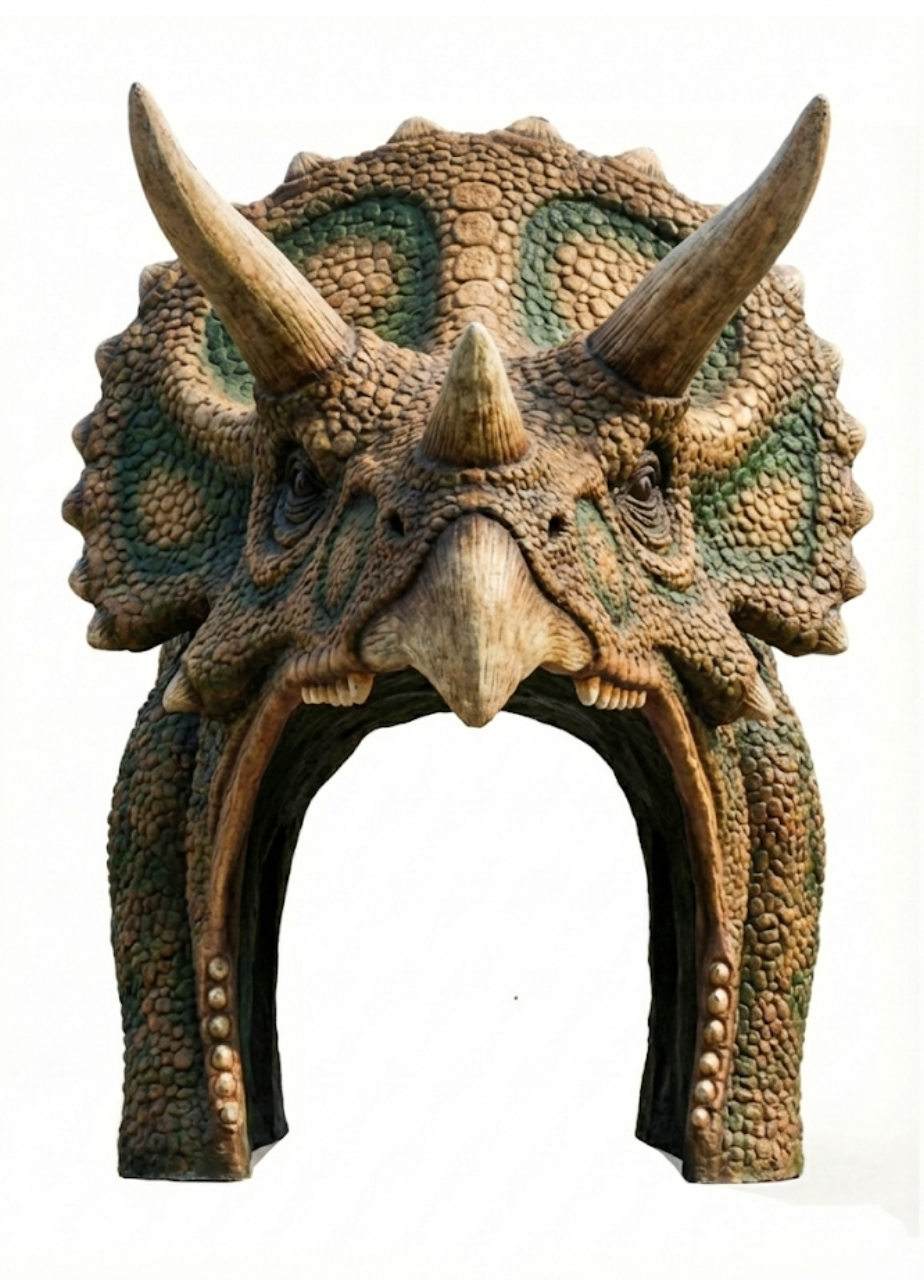
This Triceratops horridus model is crafted with meticulous attention to the latest ceratopsian paleontological research. The frill morphology reflects fossil evidence from the Hell Creek Formation, featuring accurate epoccipital arrangements and a symmetrical epijugal horn core structure. The skin texture incorporates pebbly squamation patterns consistent with published Triceratops skin impressions, with scale granularity varying across the frill margin, facial region, and body. Osteoderms along the frill edge are individually modeled with anatomically correct spacing and orientation. Muscle insertion points on the squamosal and jugal bones align with biomechanical studies of ceratopsian jaw mechanics. Sculpted in ZBrush at high-poly resolution, this model preserves micro-details such as vascular grooves on the nasal horn sheath and subtle wrinkle folds around the oral cavity.
Topology, Rigging & Sculpting Pipeline
The mesh uses a quad-dominant topology optimized for clean deformation during animation. Edge loops follow natural muscle directions across the frill, neck shield, and jaw to minimize stretching in walk, run, and head-shake cycles. The UV layout employs a non-overlapping UDIM workflow across 4 tiles, maximizing texel density on the face and frill where detail matters most. Textures are created using a full 8K PBR pipeline—including Diffuse/Albedo, Normal, Roughness, Displacement, and Ambient Occlusion maps—for photorealistic rendering in both real-time engines and offline renderers. The rigging system includes 142 bones with an advanced muscle setup that simulates jaw flexion, frill tension, and subtle facial expressions via IK/FK switchable controls on all major limbs.
Compatibility & Production Use Cases
Available in FBX, OBJ, USD, glTF, and Blend formats for seamless integration with Blender, Maya, 3ds Max, ZBrush, Unreal Engine 5.4+, and Unity 2022+. Perfect for VFX feature film paleoreconstruction, documentary-quality dinosaur sequences, AAA game creature assets, virtual reality educational experiences, museum-grade interactive exhibits, and high-resolution 3D printing of physical replicas.